
Good ducting takes the cooled air from the cooler to where people work with as little loss as possible. Keep duct runs short and straight, size the duct to the cooler outlet, release the air through diffusers above the work areas, and give warm air a way out on the opposite side.
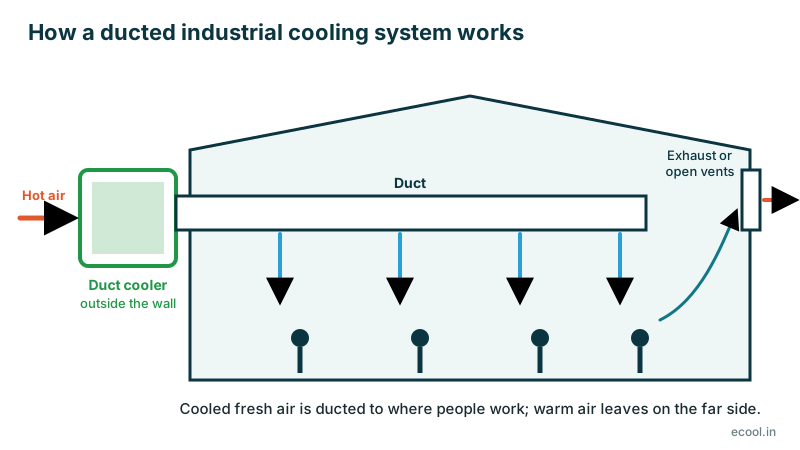
The parts of a ducted system
- The cooler, outside the building on a wall bracket, stand or roof platform
- The main duct, entering through the wall or roof
- Branches and diffusers or grills, releasing air over work areas
- Exhaust: open doors, louvres, roof vents or exhaust fans on the far side
Choosing the discharge direction
Our duct coolers discharge from the top, bottom or side:
- Side discharge: cooler on a wall bracket, duct straight through the wall. The simplest and most common.
- Down discharge: cooler on the roof, duct dropping into the space below.
- Top discharge: cooler on the ground, duct rising and turning into the building.
Layout rules
- Short and straight: every metre and every bend costs airflow
- Gentle bends rather than sharp elbows
- Duct size matched to the outlet: our outlets run from 670 × 670 mm to 900 × 900 mm; a duct squeezed smaller chokes the cooler
- Diffusers where people are, not blowing into empty roof space
- Balanced outlets, so the last diffuser still gets air
- Sealed joints, so cooled air is not lost on the way
One big duct or several coolers?
For long buildings, several coolers each feeding a short duct usually work better than one cooler feeding a very long duct. Each zone gets full airflow and one unit can be serviced while the others run.
Do not forget the exhaust
A ducted cooler supplies fresh air continuously. If it cannot leave, pressure and humidity build and the cooling falls off. Plan openings or exhaust fans opposite the supply.
Common mistakes
| Mistake | Result |
|---|---|
| Duct smaller than the cooler outlet | Low airflow, noisy cooler |
| Too many sharp bends | Little air at the far end |
| Diffusers too high | Cool air never reaches people |
| No exhaust path | Humid, stuffy shed |
| Long duct on an axial cooler | Consider a blower cooler |
Get a layout
We design and install ducting across India. Site visits are free in Mumbai and nearby Maharashtra; elsewhere a visit fee applies. See duct air coolers and our projects.
Frequently asked questions
How is an industrial cooler connected to ducting?
The cooler sits outside and its outlet joins a duct through the wall or roof; diffusers release the air over work areas.
Which discharge is best: top, bottom or side?
Side discharge through a wall is simplest; down discharge suits roof-mounted coolers; top discharge suits ground-mounted units.
How long can the duct be?
Shorter is better. For long buildings, use several coolers with short ducts, or a centrifugal blower cooler for longer runs.