
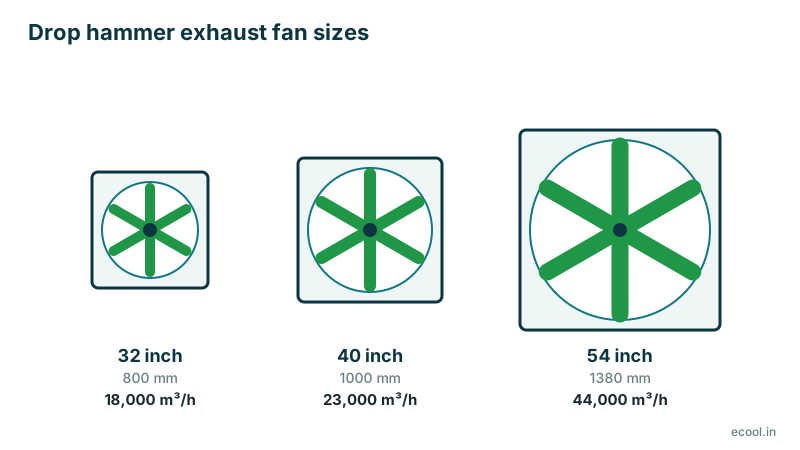
To size exhaust fans, multiply the room volume by the air changes per hour you need, then divide by the airflow of one fan. A 54 inch drop hammer fan moves about 44,000 m³/h, a 40 inch fan 23,000 m³/h and a 32 inch fan 18,000 m³/h.
The formula
Number of fans = (length × width × height × air changes per hour) ÷ airflow per fan
Use metres for the room and m³/h for the fan.
Step 1: room volume
Length × width × average height. A shed 40 m × 20 m with an average height of 7 m holds 5,600 m³.
Step 2: choose air changes per hour
The hotter, smokier or more crowded the space, the more air changes it needs. These ranges are common rules of thumb; a ventilation consultant can set the figure for your process.
| Space | Typical air changes per hour |
|---|---|
| Storage warehouse, godown | 6 to 10 |
| General factory or workshop | 10 to 20 |
| Hot processes: foundry, moulding, ovens | 20 to 40 |
| Commercial kitchen | 20 to 30 |
| With evaporative coolers | Match the coolers' total airflow |
Step 3: divide by the fan airflow
For the 5,600 m³ shed at 15 air changes: 5,600 × 15 = 84,000 m³/h.
- 54 inch fans: 84,000 ÷ 44,000 = 1.9, so 2 fans
- 40 inch fans: 84,000 ÷ 23,000 = 3.7, so 4 fans
- 32 inch fans: 84,000 ÷ 18,000 = 4.7, so 5 fans
Step 4: place the fans
- Put exhaust fans on the wall opposite the air inlets, so air crosses the whole floor
- Mount them high, where the hot air collects
- Keep inlets (doors, louvres, cooler outlets) open; a fan cannot pull air from a sealed room
- Spread fans along the wall rather than grouping them in a corner
Exhaust fans with industrial coolers
Evaporative coolers push fresh air in; that air must leave. Size the exhaust close to the coolers' combined airflow. Four 30,000 CMH coolers supply 120,000 m³/h, which three 54 inch fans can remove.
Which fan size?
Fewer large fans mean fewer wall openings and motors. Smaller fans fit lower walls and give finer control. All three sizes come in belt drive or direct drive, made in India with SS-304 blades.
See exhaust fans.
Frequently asked questions
How do I calculate how many exhaust fans I need?
Room volume in m³ × air changes per hour ÷ the airflow of one fan in m³/h, rounded up.
How many air changes per hour does a factory need?
Commonly 10 to 20 for a general factory and 20 to 40 for hot processes; confirm for your process.
How much air does a 54 inch exhaust fan move?
About 44,000 m³/h.